Imaging & DetectorsIt ships more detectors every year — and earns less on each one.
Imaging & Detectors
It ships more detectors every year — and earns less on each one.
Every year the world takes more X-ray images, and every year the panel that captures them sells for less. The merchant flat-panel-detector market is a textbook case of what one imaging-research house calls 'rising volumes, falling prices': unit demand compounds in the mid-single digits while the price of a detector erodes, and the value migrates up to the systems, software and AI wrapped around it. This is a study of that market — its commoditizing core, the faster machine-vision business detector makers run beside it, and the Chinese supply that is both its biggest demand engine and its sharpest margin threat — read through Korea's Vieworks, the one Korean merchant detector maker that stayed profitable while its peers went into the red.
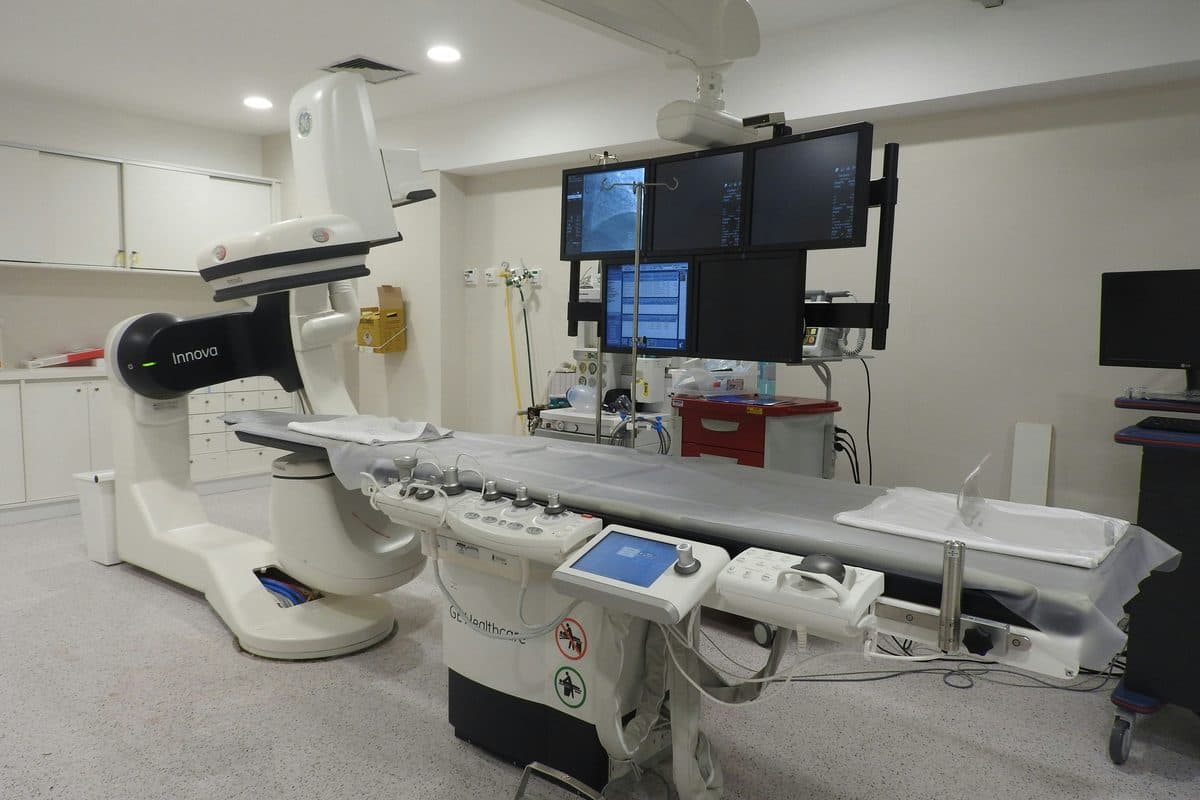
A fluoroscopy-and-angiography imaging suite. A merchant maker like Vieworks does not sell the room — it sells the flat-panel detector at the heart of it, the component that turns a burst of X-rays into a digital image. That component is where this study lives: a market that adds units every year and loses price on each one, while the value pools in the system and the software around the panel.
Every year, the world takes more X-ray images than the year before. Aging populations, the slow replacement of film and computed radiography by digital capture, and first-time imaging across emerging markets all push the same direction: more exposures, more panels, more sockets to fill. And every year, the digital detector that captures those images — a flat sheet of glass or plastic, a scintillator, a thin-film transistor array, the component that converts a burst of X-rays into a picture — sells for a little less than it did the year before. The imaging-research house Signify Research has a name for the resulting market: rising volumes, falling prices.
It is one of the cleaner examples in medical technology of a market that grows in units while it shrinks in price, and where the money quietly migrates somewhere else. Strip the X-ray business into layers and the pattern is stark. The whole digital-X-ray system — the machine, its software, its service — is roughly a US$15 billion market in 2025 compounding around 8 percent a year; the detector inside it, sold on the merchant market, is a US$3–4 billion business growing only 5–6 percent; and the narrowest flat-panel-detector slice grows slower still. This is a study of that detector market — its commoditizing core, the faster machine-vision business many detector makers run alongside it, and the Chinese supply that is at once its biggest demand engine and its sharpest margin threat — read through one company that sits squarely inside all three: Korea's Vieworks.
The detector is the slow layer of a faster market
~US$3–4bn
The merchant X-ray-detector market in 2025 (MarketsandMarkets ~US$3.8bn; Mordor ~US$4.6bn for 2026), growing ~5–6% — sitting inside a ~US$15bn whole-system digital-X-ray market growing ~8%. Flat-panel detectors are ~70%+ of the detector basket while computed radiography declines (~−2%/yr). The component grows slower than the system because price erosion pushes value up to software and service. Sources: MarketsandMarkets; Mordor Intelligence; Signify Research.
We use cookies to understand how our site is used so we can improve it. Necessary cookies are always on. You can accept all, reject all, or choose what to allow. Learn more
Rising volumes, falling prices
The unit engine is real and durable. Direct radiography now accounts for roughly 84 percent of the digital-X-ray technology base and is still rising as the last computed-radiography and film rooms convert; image intensifiers are being phased out for flat panels; emerging markets are buying their first digital systems. Every one of those is a net-new detector socket. But underneath the volume sits the force that defines the market for the people who make the panels: price. Signify Research models medical flat-panel-detector revenue growing only about 4 percent a year even as units grow faster — the gap between the two is ASP erosion, and it is worst in the commodity amorphous-silicon panels that make up the floor of the market. The value that the price erosion strips out of the detector does not vanish; it migrates up the stack, to the system OEM, the image-processing software and the AI.
That dynamic splits the market in two. There is a commodity floor — static amorphous-silicon panels, where the only competition is price and the direction is down — and a premium ceiling, where image quality, weight, dose efficiency and durability still command a price the floor cannot: CMOS and IGZO backplanes, glass-free and flexible substrates, dynamic detectors for fluoroscopy and surgical C-arms, high-resolution mammography. A merchant maker that stays on the commodity floor is structurally squeezed; the only durable ground is to keep climbing toward the ceiling faster than the floor rises to meet it. The clearest way to see that squeeze is to watch it land on a single company's margin.
A record top line, a halved margin: the squeeze on one merchant maker's P&L
Read the two lines against each other. Through 2019–2022 this was an 18–19 percent operating-margin business — a premium merchant detector maker earning premium margins. Then 2023 reset it: margin halved to roughly 8.5 percent on a mix shift and a demand shock in its China and Korean-OEM channels, and it has hovered near 9 percent since. The revenue line, meanwhile, barely flinched and reached a record in 2025. That is the squeeze in a single picture — flat-to-rising volume, a margin cut in half. The early-2026 quarter shows margin recovering toward 15 percent on cost discipline and a richer product mix; whether that holds is the whole bet, and it rests entirely on the premium ceiling holding its price.
The core that is commoditizing. General radiography — the everyday chest and bone X-ray — is the detector market's volume base and its price battlefield at once: units keep rising as the world digitizes, but it is here, in the static amorphous-silicon panel, that ASP erosion bites hardest. The premium tiers exist precisely to escape this picture.
Two clocks
A merchant detector maker is really two businesses running on one underlying competence — optics, high-resolution image sensors, and real-time image processing. One business is the mature medical-detector clock, growing the market's 5–6 percent. The other is a machine-vision and industrial-imaging clock that ticks far faster: the same sensors and cameras, pointed at a factory line instead of a patient. Industrial X-ray inspection of EV-battery cells, semiconductor and advanced-packaging inspection, display inspection — these markets grow at two to four times the rate of medical X-ray's ~3.3 percent. For a maker squeezed on the medical core, the industrial clock is the growth the core cannot supply.
Market
2025 size
CAGR to ~2030
Read
X-ray detector (component)
~US$3.4–4.6bn
~5–6%
Mature core; price-eroded
Whole-system digital X-ray
~US$15bn
~8%
Where the value migrates
Machine-vision camera
~US$6.7bn
~8.6%
The faster second clock
EV-battery X-ray inspection
~US$0.2bn
~13–15%
Steepest inspection vertical
Semiconductor X-ray inspection
~US$3.2bn
~10% (metrology)
AI / HBM-packaging pull
The two clocks a merchant detector-and-camera maker runs. The medical-detector core is mature; the machine-vision and inspection markets grow two-to-four times faster. 2025 sizes and forecast CAGRs to ~2030; houses disagree on scope, so figures are directional ranges. Sources: MarketsandMarkets; Mordor Intelligence; Grand View Research; Valuates/QYResearch; Signify Research.
The faster clock. The same sensor-and-camera competence that builds a medical detector also builds a machine-vision camera — and aimed at an automated production line, at EV-battery cells, or at semiconductor packaging, it sells into markets growing two-to-four times faster than medical X-ray. For a squeezed detector maker, the industrial business is the growth the core cannot give.
China: the demand and the squeeze
The single most important force acting on this market comes from one country, and it cuts both ways. China is simultaneously the fastest-growing region of detector demand and the source of the most aggressive low-cost supply — the same geography that pulls a Korean maker's volume also drives the price erosion that compresses its margin. The instrument of that squeeze is Shanghai-listed iRay, which built a vertically integrated, heavily automated, aggressively priced detector business: 2025 revenue of about RMB 2.25 billion (~US$313 million, up roughly 23 percent) at a net margin near 29 percent, the world's number-two merchant medical-FPD vendor at around a fifth of global share — and now climbing out of commodity amorphous-silicon into the IGZO, CMOS and dynamic tiers where the premium has always lived. iRay already out-scales every Korean detector maker, and Signify credits its model with eroding margins across the entire sector.
The cost frontier that does not stop rising
~US$313M · ~29%
iRay's 2025 revenue (~+23% YoY) and net margin — the world's #2 merchant medical-FPD maker at ~20% global share, built on vertical integration and automation. Already larger than any Korean detector maker, and climbing from commodity panels into the IGZO/CMOS/dynamic premium tiers that have been the Korean makers' refuge. Sources: iRay (SSE 688301) FY2025 results; Signify Research.
The other flank is captive supply. A large slice of detector demand never reaches the merchant market at all: Trixell, the medical-FPD share leader at over 18 percent, is a joint venture owned by Thales, Philips and Siemens — it supplies its own co-owners; Canon, Fujifilm and Konica Minolta each design and build detectors in-house for their own systems. Every system maker that builds or co-owns its detector is demand foreclosed to a merchant supplier. Squeezed from below by Chinese cost and from the side by captive OEM supply, the addressable merchant market a maker like Vieworks can actually serve is narrower than the headline figure — and getting narrower. Trade policy adds a third turn: US reciprocal tariffs since August 2025 put a 15 percent rate on Korean, EU and Japanese imports, while India's production-linked incentives and Indonesia's local-content rules reward building locally — friction a Korea-centric exporter feels and a US- or China-localized rival can sidestep.
Maker
Latest-FY revenue
Position
Profitability signal
Trixell (FR)
private
Captive JV — Siemens / Philips / Thales
>18% medical-FPD share
Varex (US)
~US$845M
Merchant pure-play (+ X-ray tubes)
Profitable; +4% revenue
iRay (CN)
~US$313M
Vertically-integrated low-cost
~29% net margin; #2 FPD
Vieworks (KR)
~US$176M
Premium-tilted merchant + cameras
~9% OPM — the survivor
Rayence (KR)
~US$84M
Vatech-orbit components
−3% OPM (FY25 loss)
DRTECH (KR)
The cost frontier, made concrete. iRay's answer to a price-eroding market was vertical integration — its own scintillators and panels, an automated line, and pricing set to take share. It worked: a ~29% net margin and the world's number-two detector position. For a Korean merchant maker, competing on that cost curve is not winnable; the defensible ground is the premium panel a low-cost line cannot yet match.
The case in point: the survivor
Vieworks is worth studying because it took the premium side of that divide all the way, and lived. Through the 2023–25 squeeze that pushed both listed Korean detector peers into operating losses — Rayence to roughly −3 percent in 2025, DRTECH into a multi-year loss it only began climbing out of late that year — Vieworks was the only one still solidly profitable on a full-year basis, and the only one at a revenue record. It got there by mix: proprietary CMOS and large-area panels; glass-free, flexible substrates; a high-resolution mammography line; IGZO dynamic detectors for fluoroscopy and surgical C-arms; and — the part the price war cannot reach — a prized hybrid-TDI machine-vision camera franchise that won Korea's 'World Class Product' designation in 2025 and sells into display and semiconductor inspection.
The survivor's margin, alone in the black
~8.9% OPM
Vieworks' FY2025 operating margin — down from ~18–19% in 2019–2022, but the only listed Korean merchant detector maker still profitable through the 2023–25 squeeze (Rayence −3.4% OPM; DRTECH a multi-year loss it only began exiting in late 2025), and the only one at a revenue record. Early-2026 margin recovered toward ~15% on cost discipline and a richer mix. Sources: DART; FnGuide.
Survival is not immunity. The dynamic-detector line actually shrank in 2025 as Korean dental-CT customers' China business softened. The newest growth bet — VISQUE digital-pathology slide scanners, CE-marked in Europe in 2025 and debuting a second model at a US pathology meeting in 2026 — is still a margin drag, with no US clearance and entrenched incumbents from Leica to Philips to Hamamatsu. And iRay keeps climbing into exactly the premium tiers Vieworks depends on. The lesson the company embodies is not 'premium wins.' It is that premium is the only defensible ground, and that holding it is a race — you have to re-earn the ceiling faster than the cost frontier rises to it. A late-2025 doubling of capacity at its Hwaseong plant (₩23.5bn, from roughly 48,000 to 96,000 units a year) is the company's wager that it can.
Where the market goes to 2030
Project the market forward and two things hold at once. Units keep rising — retrofit, aging, emerging-market penetration, the conversion of the last analog rooms — but the dollar value of the detector component compounds slowly and unevenly, because every point of unit growth is met by a point of price erosion, and because the value keeps migrating up to the system, the software and the AI. The growth a detector maker can actually bank is not in the core; it is at the edges: the premium medical niches that resist price decline — dynamic, mammography and tomosynthesis, dental — and, above all, the second clock, the machine-vision and inspection businesses tied to EV batteries, semiconductor packaging and displays. The market environment a premium-tilted merchant maker faces sorts into three regimes, set by how much of the price erosion the premium mix offsets and how fast the second clock fires.
Regime
What would have to be true in the market
Where revenue lands by 2030
The second clock fires
Machine-vision inspection (battery, semiconductor/HBM) scales with a premium-medical recovery, and the premium mix outruns ASP erosion.
~₩400bn (~11%/yr)
Mix-up holds the line
Steady share gains in industrial and machine vision; premium medical roughly offsets static-panel price decline.
~₩330bn (~7%/yr)
The squeeze wins
ASP erosion outruns the premium mix; inspection capex stalls; no new leg contributes and the core sets the pace.
~₩280bn (~3%/yr)
Three demand regimes for a premium-tilted merchant detector-and-camera maker to 2030 — market-environment constructs, not a company forecast or target. Each is defined by how much of the price erosion the premium mix offsets and how fast the machine-vision and inspection clock fires; the revenue endpoints are illustrative, anchored to the segment trajectory and blended market CAGRs.
“A merchant detector is a component in a market that adds buyers every year and pays its makers less for each one. The decisive question is never who builds the sharpest image — it is who owns the premium the cost frontier cannot yet reach, and who runs a second, faster clock beside the slowing one.”
— Nathan Research Group, Medical Imaging Series N°01
The pattern is not unique to X-ray. Any market where the hardware commoditizes while the volume grows — sensors, memory, displays, connectors — rewards the same two moves: climb into the premium tier that price erosion reaches last, and stand up a faster-growing adjacent business before the core fully matures. Vieworks is a clean case because it is doing both in plain sight, and because its survival, alone among Korean detector makers, is the evidence that the premium ground is real — and the evidence, equally, that holding it is a race against a Chinese cost frontier that does not stop rising. Our full brief on the X-ray-detector and machine-vision-imaging market — the basket sizing and its scope traps, the price-erosion mechanics, the China supply dynamic, the competitive map and the two-clock outlook — is available to download with this article.
Working With Nathan Research Group
Partner With Nathan Research Group
Public filings and market forecasts establish the shape of the X-ray-detector market — the basket sizes, the price-erosion trend, the wide-band CAGRs. What they cannot show is which OEM sockets a merchant detector actually holds and for how long, how fast a vertically-integrated Chinese rival's pricing is really resetting the premium tiers, or whether a new growth leg like machine-vision inspection or digital pathology is converting design-ins into durable revenue. That intelligence lives with the imaging-system integrators, inspection-line engineers and detector buyers who specify, price and replace these panels — and reaching them, compliantly, is what we do.
Korea’s first dedicated expert network — Seoul, since 2013
Who we put in the room
Medical-imaging OEM & detector sourcing
System integrators who specify which merchant detector goes into a DR room or C-arm — on image quality, reliability, substrate breadth, and how sticky a socket really is once it is designed in.
Machine-vision & industrial-inspection systems
Engineers who deploy TDI line-scan and area-scan cameras on display, semiconductor and EV-battery lines — where the second, faster clock actually converts capex into camera demand.
China detector supply chain (iRay / CareRay)
Insiders who read how far a vertically-integrated, automated Chinese cost model can push price into the premium tiers, and how quickly it is climbing the IGZO/CMOS/dynamic ladder.
Vieworks consolidated revenue and operating margin, FY2019–FY2025 (DART, rcept_no 20260323001685). Revenue reached a record ₩239.3bn in 2025, yet operating margin more than halved — from a ~18–19% 'golden era' (2019–2022) to ~9% after a 2023 reset, as price erosion and a China/Korean-OEM channel shock landed together. Shown as evidence of the sector dynamic, not as a forecast.
~US$80M
Mid-tier merchant DR
FY25 loss; turned Q3-25
The merchant X-ray-detector hierarchy, by latest-year revenue. Varex and the Chinese disruptor iRay lead on scale; Trixell leads on medical-FPD share but is captive to its OEM owners; the Korean merchant makers sit below — and only Vieworks stayed profitable through the 2023–25 squeeze. Revenue converted at period FX; shares are scope-sensitive (merchant-FPD vs all-detector) and approximate. Sources: company filings; Signify Research; FnGuide.
Detector physicists on which backplane and scintillator transitions actually command a price premium, and which features have already become table stakes.
Digital pathology & emerging bio-imaging
Lab directors and pathologists who decide whether a whole-slide scanner is a real third leg or a margin-draining science project against entrenched incumbents.
Korean med-device manufacturing, FX & tariffs
Operators who read an export-led Korean maker's cost base — contract capacity, component sourcing, the won, and the new tariff-and-localization map that rewards building locally.
How an engagement works
1Scope
We turn your thesis into a precise expert profile and question set, mapped to the decisions you need to close.
2Source & vet
We screen and compliance-clear each expert — relevance, recency, and the absence of conflicts — before any call.
3Convene & synthesize
We arrange interviews on your timeline and, where useful, deliver written synthesis tied back to your questions.
If your team is evaluating Vieworks, the merchant X-ray-detector market, or the broader medical-imaging sector, tell us the decision you’re trying to make.
A direct reply from a partner, not an intake form.
Based solely on public sources. Nathan Research Group does not request or facilitate material non-public information, and runs every engagement through a documented compliance protocol.