Games & InteractiveA twenty-year-old game that won't stop paying — until it does.
Games & Interactive
A twenty-year-old game that won't stop paying — until it does.
Every year the world spends more on games, and every year a little less of that money flows to the genre Korea built its industry on. Korea's mobile-MMORPG market is in structural decline — its share of mobile-RPG revenue fell from 78.8 to 56.2 percent in four years as spending rotated to sub-culture and idle titles. Yet the two-decade-old trademarks underneath it keep paying: a legacy MMORPG IP does not decay, it re-platforms, resetting its revenue in a sawtooth with the richest royalties earned in China behind a political publishing gate. This is a study of that market, read through Korea's Webzen — the cohort's margin king, living off a single twenty-year-old trademark, MU.
A live mobile-MMORPG service. A licensing house like Webzen does not run the game in front of the player — it owns the trademark behind it and collects a royalty while a partner carries the cost. That trademark is where this study lives: a twenty-year-old IP that re-platforms from PC to mobile to a Chinese operator, paying its owner an extraordinary margin in a market whose native genre is quietly shrinking.
Every year, the world spends a little more on games than the year before — but the growth has slowed to a crawl, and it is no longer flowing to the genre Korea built its industry on. The global games market, measured software-only by Newzoo, sits at roughly US$185–197 billion in 2025, a low-single-digit grower where mobile is the largest segment and the slowest, and PC and console contest the fastest growth depending on the forecast vintage. Korea is the world's fourth-largest market at KRW 23.85 trillion, but its platform mix hides a deeper shift: the mobile MMORPG, the high-ARPU genre that was the cash engine of Korean publishers through the 2010s, is in genuine structural decline. Its share of Korean mobile-RPG revenue fell from 78.8 percent in 2020 to 56.2 percent in 2024, and in mid-2024 the RPG genre as a whole dipped below half of all Korean mobile spending for the first time in recorded history. The money did not vanish; it rotated to sub-culture gacha and idle games.
And yet the twenty-year-old trademarks underneath that declining genre keep paying — which is the paradox this market turns on. A top-tier MMORPG IP does not decay smoothly; it re-platforms, resetting its revenue in a sawtooth each time it crosses to a new container (PC to mobile to web), revives a classic server, or licenses into a new region. The richest of those resets is China, where a Korean owner cannot publish directly and instead licenses the trademark to a domestic operator that holds the publishing licence and remits a royalty — an extraordinary-margin annuity that sits behind a discretionary political gate. This is a study of that market — the slowing games industry, the declining MMORPG core, and the China licensing stream that funds the highest margins in the cohort — read through one company that lives at the centre of all three: Korea's Webzen, a hyper-profitable house built almost entirely on a single MMORPG trademark, MU.
We use cookies to understand how our site is used so we can improve it. Necessary cookies are always on. You can accept all, reject all, or choose what to allow. Learn more
MMORPG's share of Korean mobile-RPG revenue, 2020→2024, as spending rotated to idle (1.7%→16%) and sub-culture gacha. The RPG genre as a whole first dipped below 50% of all Korean mobile spend in mid-2024. The same rotation drove NCSoft — the Lineage giant — to its first annual operating loss in 26 years in FY2024 (operating loss KRW 109.2bn on revenue KRW 1.58tn, though net income stayed positive at KRW 94.1bn). Sources: Sensor Tower; KOCCA 2025 Korea Game White Paper; NCSOFT IR.
A maturing market, a declining core
Two facts scope everything that follows. First, the games market stopped growing fast. The software market is a low-single-digit grower into 2027; the spectacular CAGRs that circulate belong to broad-scope trackers that bundle hardware, advertising and streaming, a definitional gap of three to four times rather than faster growth. Second, and decisively, the specific genre a legacy MMORPG IP lives in is in structural decline in its home market. Korea's platform mix is the giveaway: mobile is 59 percent of the market and PC 25 percent, but console is just 5.0 percent — against roughly 24 to 28 percent globally — which is why every Korean publisher's 'console pivot' is an export play, not a domestic one. There is no home console demand to capture.
The decline of mobile MMORPG is not a soft trend; it is being out-competed by cheaper, lighter formats that captured the young spender it lost. A Chinese-made idle game, Legend of Mushroom, was Korea's number-three highest-grossing mobile title over January–October 2024 and its most-downloaded; idle's share of Korean mobile-RPG revenue rose from 1.7 percent to 16 percent in four years. The highest-LTV young cohort migrated to character-driven sub-culture gacha, where HoYoverse's Honkai: Star Rail earned US$870.9 million on mobile in 2024, out-earning Genshin Impact's roughly US$730 million mobile that same year (Genshin's all-platform lifetime spend crossed US$10 billion by end-2025, but its mobile leg is past peak). Layered on top is monetization regulation — mandatory loot-box-odds disclosure since March 2024, plus a record KRW 11.6 billion fine on Nexon — which raises the cost of the very PvP-gacha model that powered Korean MMORPG. For a legacy-IP house, the genre rotation cuts two ways: it caps the value of any new domestic launch, while making the old trademark more valuable as a re-skinnable asset that can be ported into idle, sub-culture or console containers for export.
The content treadmill. A legacy-IP house keeps a twenty-year-old MMORPG alive by running perpetual live-ops and a cadence of new titles — MU extensions onto idle and action containers, plus its first genuinely new IP. The trademark only pays if the next platform-wave keeps arriving; between waves, the royalty fades. This is the operating reality behind the high-margin annuity.
The sawtooth: an IP that re-platforms rather than decays
The headline finding about old MMORPG IPs is that the top tier does not decay — it re-platforms. The revenue curve is a sawtooth, where each new platform, classic-server revival, or regional licence resets it upward; the 'long tail' is really a series of new heads. MapleStory, MU's exact vintage, grew about 46 percent year-on-year in its twentieth year. Lineage's mobile franchise crossed US$7 billion lifetime. The Legend of Mir trademark — a Korean IP whose Chinese derivatives Gamma Data values at a cumulative IP ecosystem exceeding RMB 370 billion (and roughly RMB 30 billion a year in stable revenue) — is the proof that a single MMORPG trademark can sustain a multi-billion-dollar, decades-long annuity, with one operator paying around US$380 million for five years of China rights. What sustains a twenty-year MMO is a long-tenured core that does not need new players to survive, plus recurring re-platforming and licensing waves that import new — often younger, often regional — players onto the old IP.
That dynamic produces a distinctive financial shape, and the clearest way to see it is on a single company's record. The licensing-and-royalty model earns an extraordinary margin — the licensee carries development, marketing and operating cost, so the owner collects a near-zero-marginal-cost revenue share — but it also produces a melting top line as each licensed wave fades to the next. The result is not a manufacturer's reset-and-recover cycle; it is the slow fade of a legacy annuity, punctuated by the spikes of each new platform-wave.
A melting annuity: extraordinary margins on a revenue line down ~40% from its peak
Read the two lines together. Through 2020–2022 this was a 34–37 percent operating-margin business — a hyper-profitable trademark earning hyper-profitable margins because it licensed its IP rather than self-operating at cost. Then the curve faded: margin slid to 25 percent in 2023–2024 and to 17 percent in 2025 as the MU cash curve aged, on revenue down some 40 percent from the peak to its lowest level since 2018. The brief 2024 uptick was a wave, not a turn — the launch of MU Monarch 2 lifted the franchise about 47 percent in the first half of 2024, then it fell roughly 27 percent in the first half of 2025: the sawtooth inside a single year. That is the whole shape of a legacy-IP annuity, and the entire question is whether a next wave arrives before the last one fully runs down.
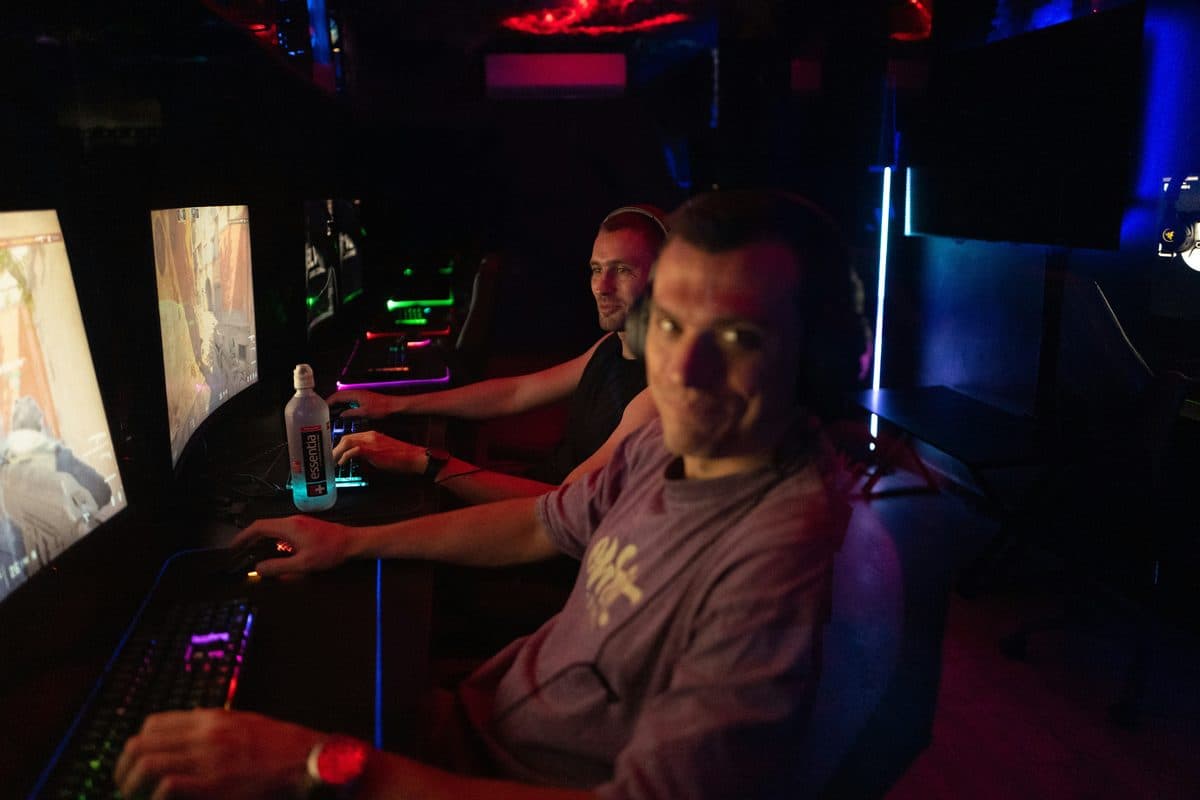
The genre rotation, on a screen. The young, high-LTV spender that mobile MMORPG lost went to character-driven sub-culture gacha and to idle games — a Chinese-made idle title was Korea's number-three grosser in 2024. A legacy-IP house can re-skin its trademark into either container, but it competes there against HoYoverse-scale incumbents and a commoditized idle field; the IP, not the genre, is the only durable edge.
China: the royalty engine behind a gate
For a Korean MMORPG-IP house, China is where the trademark earns its keep — and it is the single structural variable that sets the regime. Korean firms cannot publish directly in mainland China; the IP owner licenses the trademark to a domestic operator that holds the banhao — the mandatory publishing licence issued by the NPPA, without which a game cannot legally monetize — and remits a revenue-share royalty. The economics are extraordinary for the licensor: Webzen's flagship licensed title, the 'MU for All' mobile derivative developed by Tianma Time and published by Kingnet, earned about US$1.1 billion cumulatively by 2017, with royalties arriving at roughly KRW 100 million a day at peak. The terms — a tiered single-digit royalty on net revenue, per the operator's own exchange filing — sit at the low end of the licensing band, but applied to enormous volume. The trade-off is the model's signature: maximum margin, minimum control.
Maximum margin, minimum control
~33% of revenue
China-led royalty/licensing as a share of Webzen revenue — the near-zero-cost, highest-margin slice, paid by Chinese operators on MU-family titles. China is consistently Korea's #1 game-export destination (~25–30% of ~US$8.5bn exports). The royalty arrives behind the banhao gate, which froze for Korean titles for ~5–6 years after the 2017 THAAD dispute (no Korean game licensed until Dec 2022) and whipsawed overnight in the Dec-2023 draft-rules shock. Sources: Webzen filings; KOCCA; Kingnet SZSE filing; NPPA.
The royalty only flows while the licensee holds a banhao, and that gate is the structural risk. Foreign titles run on a separate, smaller, less-frequent 'imported' track subject to an undisclosed de-facto quota; its issuance history reads as a near-total freeze, a strong thaw, and a recent normalization — 44 imported approvals in 2022, 98 in 2023, 110 in 2024, 95 in 2025. On top of that whole-market cadence sits a Korea-specific layer: after the 2017 THAAD deployment, China's unofficial cultural embargo meant not a single Korean game received a banhao for roughly five to six years, until December 2022. The whole-market layer is just as volatile — December 2023's draft monetization rules erased tens of billions of dollars off Tencent and NetEase in a single day (combined intraday losses above US$60 billion), then were softened within days and withdrawn within about a month. The defining feature is volatility, not a fixed rulebook: discretionary, opaque, fast-moving, and reversible in weeks.
Market
Latest size
Trajectory
Read
Global games (software)
~US$185–197bn
Low-single-digit
Mobile largest & slowest
Korea games (KOCCA)
~KRW 23.85tn
+3.9% in won
4th globally; console ~5%
Korea mobile MMORPG
share 56.2%
78.8%→56.2% (4yr)
Structural decline
China games (GPC)
~RMB 350.8bn
+7.7% YoY
#1/#2 globally; the gate
China imported banhao
95 (2025)
44/98/110/95 cadence
Thaw, then slight pullback
The two markets a legacy-MMORPG-IP house lives between — a slowing global software market and a declining domestic genre — plus the China gate that funds the richest royalties. 2024–2025 sizes; houses disagree on scope, so figures are directional ranges. Sources: Newzoo (software-only); KOCCA 2025 Korea Game White Paper; Sensor Tower; GPC/CNG China data; NPPA via Niko Partners.
The gate the royalty passes through. A Korean trademark earns its richest margin in China only by licensing to a domestic operator that holds the banhao and runs the game. That publishing licence is discretionary and politically exposed — it froze for Korean titles for years after THAAD and whipsawed overnight in 2023 — which makes a legacy-IP house's most profitable revenue also its least controllable.
The case in point: the margin king of a shrinking field
Webzen is worth studying because it monetized the legacy-IP model as profitably as anyone in its cohort — and shrank doing it. Placed against its Korean mid-cap peers, it occupies a distinctive quadrant: the highest margin, on a declining top line. The cohort sorts on a single trade-off — how a publisher chose to play its legacy IP. Webzen licensed the MU trademark and kept a 17 percent margin no peer matches, but its revenue fell to a multi-year low. Wemade, the closest structural comparable — a legacy-MMORPG-IP and China-royalty house built on the Mir franchise — chased growth via the WEMIX blockchain platform (delisted twice in Korea) and global launches, roughly doubling revenue to KRW 614 billion but at about 1.7 percent operating margin and an outright net loss. Joycity, with no anchor IP at MU's scale, drifted to KRW 140 billion at roughly 4 percent. Even NCSoft, the Lineage giant, fell to its first operating loss in 26 years. The lesson generalizes: in a maturing genre, how profitably you monetize a legacy IP matters more than how fast you grow the top line.
Company
FY25 revenue
FY25 OPM
Position
Webzen
~KRW 174bn
17.0%
Margin king, shrinking
Wemade
~KRW 614bn
1.7%
Grew on blockchain, net loss
Joycity
~KRW 140bn
4.1%
No anchor IP, drifting
NCSoft
~KRW 1.58tn
loss
First OP loss in 26 yrs
The Korean games mid-cap cohort, FY2025 — the profitability-versus-growth trade-off. Webzen is the margin king on a shrinking top line; Wemade grew revenue ~2x but to near-zero margin and a net loss; Joycity has no anchor IP. Revenue and margin from DART consolidated financials; NCSoft shown as context. Sources: DART (069080 / 112040 / 067000); company FY2025 results; FnGuide.
Webzen got to that margin by single-IP concentration: the MU franchise is roughly two-thirds to 70 percent of revenue, the rest spread thinly across the published Metin2, the aging R2 franchise and a long tail. That concentration is the source of both the margin (a proven, monetizable, two-decade trademark) and the risk (no second engine of comparable scale) — though it is an industry pattern, not a Webzen anomaly: Gravity's Ragnarok is some 81 percent of its revenue, NCSoft's Lineage about 70 percent. The uncomfortable fact Korean trade press keeps flagging as 'one-IP risk' is that Webzen's stated plan to reduce MU dependence has, until now, mostly meant launching more MU titles — idle and action ports, global extensions. The genuine diversification bet is the new-title pipeline, headlined by a first self-developed sub-culture IP aimed at the genre that captured the young spender MMORPG lost. Survival here is not immunity: the dynamic stream fades between waves, the new sub-culture bet faces a HoYoverse-dominated field, and the China gate can close. The company embodies a single lesson — premium licensing is the only defensible ground, and holding it is a race against the cadence of the next wave.
Where the market goes to 2030
Project the market forward and the regime turns on two variables above all others: the China banhao gate — does it stay open for Korea — and the next platform-wave cadence — does a new licensed MU wave or a genuinely new hit land. Everything else (genre rotation, gacha regulation, AI-driven live-ops cost cuts, the won) modulates the slope, but those two set the regime. Beneath them, the structural backdrop holds: the games market grows low-single-digit, the domestic mobile-MMORPG genre keeps declining, and a legacy-IP house's upside is pushed offshore — into China, Southeast Asia, global, and the idle, sub-culture and console containers reachable only by re-skinning the trademark for export. The market environment a legacy-IP licensing house faces sorts into three regimes, set by whether the gate stays open and whether the next wave inflects.
Regime
What would have to be true in the market
Where revenue lands by 2030
The next wave inflects
The China gate stays open and a new licensed MU wave re-enters the top-grossing charts, while a new sub-culture or idle/global title scales — the annuity re-accelerates.
~₩270bn
Managed decline
The gate stays open but selective; licensed waves arrive lumpy (the sawtooth), MU extensions and published titles soften the fade; margin stabilizes in the high teens.
~₩165bn
The gate closes
A THAAD-style freeze or a sticky China monetization clampdown lands, and the legacy IP finds no next container — the royalty annuity decays with no fresh wave.
~₩120bn
Three demand regimes for a legacy-MMORPG-IP licensing house to 2030 — market-environment constructs, not a company forecast or target. Each is defined by whether the China banhao gate stays open for Korea and whether a next platform-wave or new hit lands; the revenue endpoints are illustrative, anchored to the segment trajectory and the licensing-annuity dynamic.
“A legacy MMORPG IP is a re-platformable trademark, not a decaying asset — it adds new players on each new container and pays its owner an extraordinary margin while it does. The decisive question is never who builds the best game; it is whether the next platform-wave arrives before the last one fades, and whether the gate to its richest royalties stays open.”
— Nathan Research Group, Games & IP Series N°01
The pattern is not unique to games. Any market where a durable asset throws off a high-margin annuity that fades between cycles — patents, catalogue music, franchise IP, licensed brands — rewards the same two moves: re-platform the asset into a new container before the last one runs down, and stand up a genuinely new engine before the core fully matures. Webzen is a clean case because it is doing both in plain sight — porting MU into idle and global containers while betting on a first non-MU IP — and because its margin leadership, alone among its shrinking cohort, is the evidence that monetizing a legacy trademark profitably beats chasing top-line growth, and the evidence, equally, that holding the line is a race against a genre rotation and a political gate that no company controls. Our full brief on the games and legacy-IP-licensing market — the genre-rotation mechanics, the China banhao dynamic, the royalty economics, the competitive map and the two-pivot outlook — is available to download with this article.
Working With Nathan Research Group
Partner With Nathan Research Group
Public filings and market trackers establish the shape of the games and legacy-IP-licensing market — the basket sizes, the genre-rotation curves, the banhao-issuance counts. What they cannot show is whether a China-licensed MU title will actually renew its publishing licence and re-enter the top-grossing charts, how durable the royalty rate really is at the next renewal, or whether a brand-new sub-culture IP has a credible path in a HoYoverse-dominated genre. That intelligence lives with the developers, China operators, banhao consultants and IP-licensing executives who build, publish and price these games — and reaching them, compliantly, is what we do.
Korea’s first dedicated expert network — Seoul, since 2013
Who we put in the room
Korea→China game-IP licensing & royalty terms
Licensing executives who structure the sublicence — the tiered net-revenue royalty, the minimum guarantee, the renewal economics — and read how a twenty-year-old trademark's rate holds, or slips, at the next term.
China banhao / NPPA publishing access
Operators and consultants who track the imported-game approval cadence and a Chinese publisher's standing with the NPPA — the single variable that can re-rate a Korean royalty engine up or freeze it for years.
Mobile-MMORPG live-ops & monetization
Producers who run high-ARPU PvP MMORPGs through the genre's decline — what caps the value of a new launch as players rotate to sub-culture and idle, and how gacha-disclosure rules reset the model.
Webzen consolidated revenue and operating margin, FY2019–FY2025 (DART, rcept_no 20260318000593). Revenue fell to KRW 174.4bn in 2025 — its lowest since 2018, roughly 40% below the 2020 peak of KRW 294.1bn — while operating margin more than halved, from a ~34–37% peak to 17.0%, as the MU franchise faded between platform-waves. The 2024 uptick was a wave (MU Monarch 2), not a turn. Shown as evidence of the sector's licensing-annuity dynamic, not as a forecast.
Sub-culture & idle genre rotation
Studio leads on character-driven gacha and idle RPGs — whether a legacy-IP house can credibly build a durable sub-culture franchise, or only re-skin its trademark into a commoditized idle slot.
Legacy-IP re-platforming economics
Veterans of the PC-to-mobile-to-global remake wave who read which old MMORPG IPs reset their revenue curve and which simply decay — the cadence question that defines a licensing annuity.
Korean games cohort, FX & capital strategy
Analysts who read a cash-rich, single-IP publisher's options — the profitability-versus-growth trade-off across the mid-cap cohort, the won's effect on export royalties, and capital returns against a fading core.
How an engagement works
1Scope
We turn your thesis into a precise expert profile and question set, mapped to the decisions you need to close.
2Source & vet
We screen and compliance-clear each expert — relevance, recency, and the absence of conflicts — before any call.
3Convene & synthesize
We arrange interviews on your timeline and, where useful, deliver written synthesis tied back to your questions.
If your team is evaluating Webzen, the legacy-IP games-licensing market, or the broader games sector, tell us the decision you’re trying to make.
A direct reply from a partner, not an intake form.
Based solely on public sources. Nathan Research Group does not request or facilitate material non-public information, and runs every engagement through a documented compliance protocol.