Grid EquipmentWhat you buy here is a place in the queue.
Grid Equipment
What you buy here is a place in the queue.
A power transformer ordered today came back, on the most recent industry survey available, in 128 weeks. A generator step-up unit took 144. Switchgear took 44. In a market where six suppliers carry a forward book worth about five times the largest annual reading of the entire world market, the delivery date does more work than the price — it rations the product, it sets what a slot is worth, and it decides which numbers carry information. Seven layers stand between a coil of electrical steel and an energised substation, and the queue runs through all of them. No valuation and no price target.
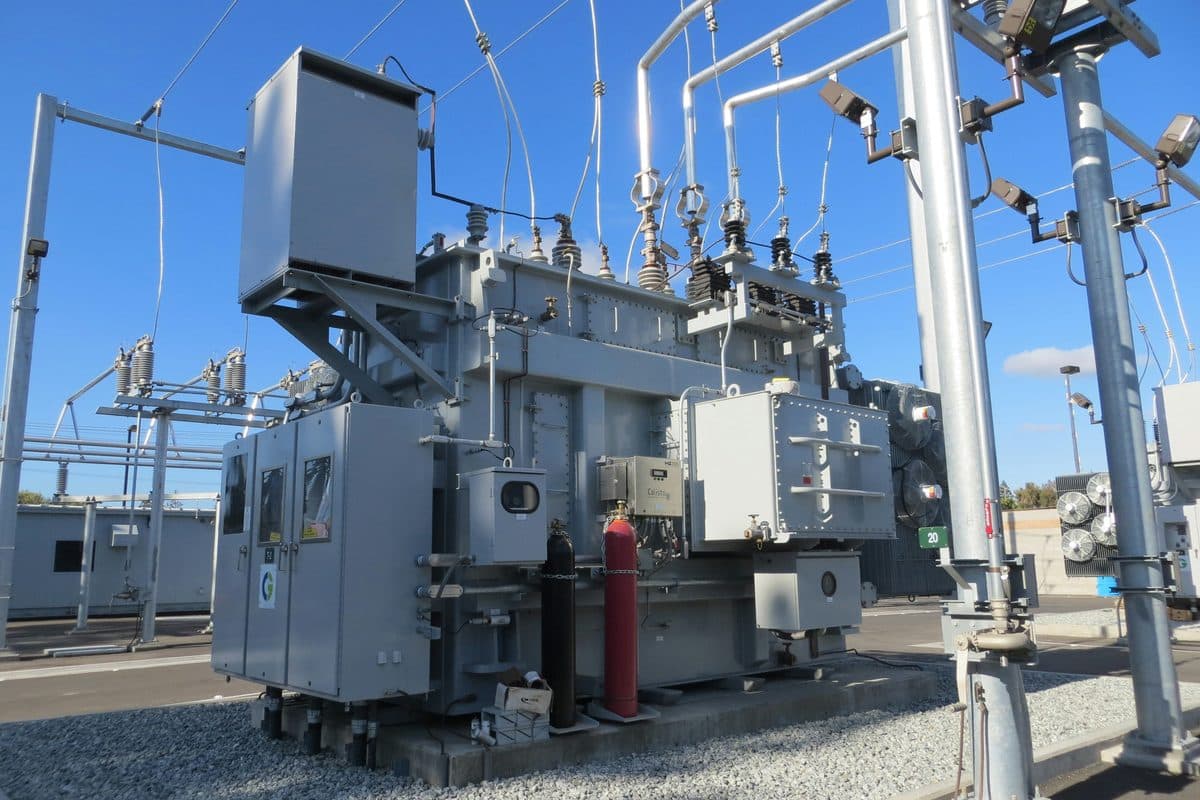
A power transformer in service. The unit itself is buildable by any qualified maker; what is scarce is the position in a production programme that produces one, and that position is what this market actually trades.
리서치 본문은 영문으로 제공됩니다.
A large power transformer is a commodity in the sense that any qualified maker can build one. It is not a commodity in the sense that matters: you cannot get one quickly. On the most recent industry survey, the average quoted lead time for a power transformer was 128 weeks, and for a generator step-up unit — the transformer that stands between a plant and the network — 144. Switchgear, by comparison, came back in 44. Those three numbers, from one survey taken in the second quarter of 2025, describe this market better than any price does. What a buyer competes for is an earlier place in somebody else's production programme.
Quoted lead time, power transformer
128 weeks
Generator step-up transformers came back at 144 weeks and switchgear at 44, on the same Q2 2025 industry survey — the most recent one located.
The survey's age is part of the story. No lead-time reading later than the second quarter of 2025 could be found, so the figure buyers, sellers and lenders quote to one another is now over a year old. The one newer reading located is narrower and worse: a 2026 Korean industry compilation puts US substation transformer lead times above 160 weeks, against roughly 140 in 2023. Whatever has happened since, it has not been an easing.
저희는 사이트 이용 현황을 파악해 서비스를 개선하기 위해 쿠키를 사용합니다. 필수 쿠키는 항상 적용되며, 전체 허용과 전체 거부, 또는 원하시는 항목만 선택하실 수 있습니다. 자세히 보기
Reading
Generator step-up transformer
144 weeks
Q2 2025 survey average
Power transformer
128 weeks
Q2 2025 survey average
Switchgear
44 weeks
Q2 2025 survey average
US substation transformers
160+ weeks
2026 compilation; ~140 weeks in 2023
Quoted lead times by equipment class. The first three rows come from one Q2 2025 industry survey and are directly comparable with each other. The fourth is a different reading entirely — a 2026 Korean industry compilation covering US substation transformers — included because it is the newest vintage located, not because it belongs on the same axis.
The book is bigger than the market
Six suppliers, reporting in four groups, carry a forward order book that comes to roughly US$160bn on our own currency conversion. Read on 2026 disclosure alone, dropping one 2024-vintage reading, it is about US$130bn. Set either figure against the annual world market for power transformers — which the three dated house readings put between US$26bn and US$32bn for 2026 — and the shape of the thing is hard to miss. That ~US$160bn compilation is about five times US$32.03bn, the largest annual market reading available. Korea's big three carry 2.4 years of revenue cover on the same arithmetic, a backlog of ₩36.7tn against ₩15.01tn of revenue. A market with that much sold forward does not clear by price in any ordinary way.
Measure
Reading
Forward order book, six suppliers in four reporting groups
~US$160bn [NRG estimate]
The same book, on 2026 disclosure only
~US$130bn [NRG estimate]
World power-transformer market, 2026
US$26–32bn
The ~US$160bn book ÷ US$32.03bn, the top of that band
~5× [NRG estimate]
Korean big-three revenue cover
2.4 years
The forward book against the annual market. Order-book figures are compiled by NRG from company disclosure at our own currency conversion and carry an estimate tag accordingly. The 2026 market band is the three dated house readings — Coherent, Persistence and Mordor — reported as a band, never averaged. The multiple is computed off the ~US$160bn compilation, not the ~US$130bn one. Revenue cover is a backlog of ₩36.7tn against ₩15.01tn of revenue for the Korean big three.
The band itself deserves a word. US$26.18bn to US$32.03bn is not a confidence interval: three houses measured the same year on three definitions, and the midpoint between them is a figure none of the three holds. So the band stays a band. The further a number sits from a filing, the wider the definitional spread underneath it.
Bushings and surge arresters at the top of a transformer. Layer 02 of seven — the plant that builds and tests this — is the layer everyone counts. The one that decides project timing sits four layers further down.
Where the Korean line actually goes
Korea's export line in large power transformers — units of 10,000 kVA and above — reached US$1.3bn in fiscal 2025, the first year above a billion dollars since 2010 and the highest ever recorded. Where it went is the more useful fact: about US$738m, some 57% [NRG estimate], went to the United States, making one destination the majority of the line. The growth rate is calmer than the level. Matched half-years give +6.7%, US$657.49m in the first half of 2025 against US$701.52m in the first half of 2026. A record year and a single-digit growth rate are not in tension here. That is what a queue looks like from outside it.
Korea's large power transformer exports, FY2025
US$1.3bn
The first year above US$1bn since 2010 and the highest on record. About 57% of it, some US$738m, went to the United States [NRG estimate].
The demand story, published in two pieces
The demand story attached to this market is a data-centre story, and it is worth being exact about what has actually been published. Goldman Sachs Research puts US data-centre power demand at 31 GW in 2025, 41 GW in 2026 and 66 GW in 2027, the last two as forecasts. Separately, HD Hyundai Electric's own planning puts data-centre-linked orders at 1.8% of its book in 2025, 6.3% planned for 2026 and 16% planned for 2027. Both series point the same way. They measure different things — one a research house's forecast of aggregate national demand, the other one company's plan for the composition of its own order book. Drawing them on a single axis would assert a relationship nobody has published, so they stay apart here.
A switchyard, which is what all of this is for. Equipment ordered in 2026 arrives into a project whose slowest component was never manufactured at all.
The layer with no supplier
Seven layers separate a coil of grain-oriented electrical steel from an energised substation: the steel, the transformer plant, the cable, the marine installation that lays it, the switchgear and its transition away from SF6, the permission to build any of it, and the buyer's order-book desk. Six of the seven have suppliers you can call, qualify and place an order with. Layer six does not. Permitting, consent and interconnection is the only layer in this chain where no amount of capital buys throughput, and it is the one most likely to decide whether equipment ordered in 2026 is energised in the decade it was ordered for. Korea passed a statute in 2025 aimed at the problem. Whether it moves a corridor faster than the ones that took twenty years is not yet answerable from the public record.
“What it sells is a place in a production programme, what prices that place is an index and a two-year-old survey, and what binds it is permission rather than iron or capital.”
— Nathan Research Group, Korea Market Series N° 02
Four things about this market are simply not written down anywhere, and a diligence outcome usually turns on one of them. Backlog composition: three of the five Korean participants publish a decomposition, no two use the same measure, and only one splits its book by destination. Segment margin: no participant publishes one for its power-equipment business, so only consolidated margins exist. The slot: no lead-time survey later than the second quarter of 2025, and no maker discloses how much of its capacity is already committed. And permission, which has no filing at all. Where the product is a date, the figure that closes a transaction is held by the engineers who quote the slot and the desks that buy it. Our full 27-page study of the seven layers — the lead-time evidence, the order-book compilation, the export line and the permitting constraint — is available to download with this article.
NRG와 함께 일하는 방식
Nathan Research Group과 프로젝트를 시작하세요.
Published sources establish the shape of this market. They do not settle the questions a diligence outcome turns on — how much of a backlog is export, what a slot is worth to the buyer holding it, whether a consent will arrive before the equipment does, and what an announced plant expansion really adds once test capacity is counted. Not one of those is answerable from a filing. That detail sits with the people who make, test, install and buy this equipment, and reaching them compliantly is what we do.
한국 최초의 전문가 네트워크 — 서울, 2013년부터
연결하는 전문가 유형
Electrical-steel and core supply
Layer 01: grain-oriented steel, the cost share it carries into a transformer, and how supply is allocated when the mills are the constraint.
Transformer plant and test engineers
Layer 02: 765 kV capability, what an announced capacity expansion really adds once test bays are counted, and how a production programme is actually sequenced.
Cable, HVDC and marine installation
Layers 03 and 04: converter stations, the lay-vessel fleet, and the queue for it — the part of a transmission project that no transformer order can accelerate.
Switchgear and the SF6 transition
Layer 05: what each regulatory gate takes out of a product line, and which qualified alternatives exist at which voltage classes.
Layer 06: the layer with no supplier, how long it holds, and whether the 2025 Korean statute moves a corridor faster than the ones that took twenty years.
Buyer-side and order-book desks
Layer 07: what a reported backlog contains and what it excludes, how utilities and data-centre developers place orders, and what a slot trades for.
프로젝트 진행 방식
1범위 설정
투자 논리를 구체적인 전문가 조건과 질문 목록으로 정리합니다. 앞두고 계신 결정에 맞춰 구성합니다.
2탐색과 검증
인터뷰 전에 전문가를 한 사람씩 확인합니다. 주제 적합성과 최근 담당 업무, 이해상충 여부를 검토해 컴플라이언스 절차를 마칩니다.
3진행과 정리
고객사 일정에 맞춰 인터뷰를 열고, 필요한 경우 질문별로 정리한 서면 요약도 함께 드립니다.
the grid equipment chain, the Korean power-equipment complex, 나아가 global transmission build-out 전반을 검토하고 계시다면, 어떤 결정을 앞두고 계신지 알려주세요.