Defense ExportA signature in 2025, a first delivery in 2030.
Defense Export
A signature in 2025, a first delivery in 2030.
Korea signed US$15.4bn of defense export contracts in 2025, 60.4% more than the year before, and holds 820 pending export orders for tanks and fire-support vehicles — the largest such queue in the world. Neither figure is revenue. The fastest commitment on the record, Poland's first executive K9 contract of August 2022, delivered all 212 howitzers inside three years. The slowest, a Chunmoo contract signed at the end of December 2025, does not begin delivering until 2030. What this market actually is, is the distance between those two schedules. The orderbook is not the question. The conversion rate is. No valuation and no price target.
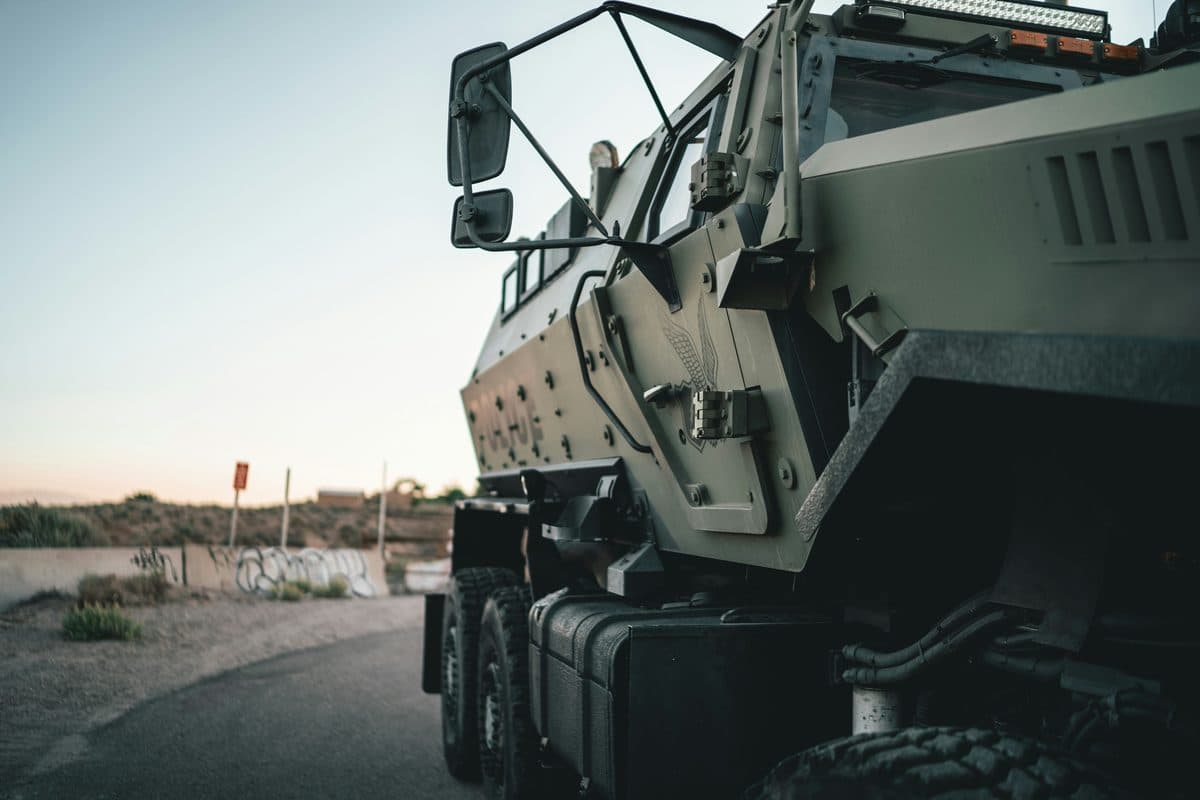
An armoured vehicle at a perimeter fence. The vehicle is the visible part of this market. What is actually traded is the layered contract behind it, and the years that sit between the date that contract is signed and the date the vehicle arrives.
리서치 본문은 영문으로 제공됩니다.
Two things are true about Korea's defense export market, and they are not the same thing. In 2025 the country signed US$15.4bn of export contracts, 60.4% ahead of the year before, booked in the year of signature. And across the five years from 2021 to 2025 it delivered 3.0% of world arms exports, ninth in the world on the trend-indicator volume SIPRI publishes — a cumulative figure for that whole window, not a reading for any single year in it. A signature is an event. A delivery is a schedule. Almost everything structural in this market sits in the distance between the two.
Year
Export contracts signed
2021
US$7.25bn
2022
US$17.30bn
2023
US$13.50bn
2024
US$9.50bn
2025
US$15.40bn
Export contracts signed by year, on DAPA figures via Seoul Economic Daily. Each year books what was signed in it; deliveries against those contracts fall in later years. The series peaks in 2022, falls twice, and recovers in 2025 to a level still below that peak. One reconciliation belongs here: the +60.4% quoted alongside this series is the source's own published growth rate, while the 2024 and 2025 points above imply +62.1% — [NRG estimate], 15.4 ÷ 9.5 − 1. Neither figure has been adjusted to the other. Nothing is shown for 2026: no outcome for that year has been published.
저희는 사이트 이용 현황을 파악해 서비스를 개선하기 위해 쿠키를 사용합니다. 필수 쿠키는 항상 적용되며, 전체 허용과 전체 거부, 또는 원하시는 항목만 선택하실 수 있습니다. 자세히 보기
That recovery is real, and it is also smaller than the growth rate makes it sound: 2025 came back above 2023 but stayed below the 2022 peak. Signed contracts are in any case only one of three measures in circulation. The second is delivered volume, which is what the 3.0% share counts. The third is company revenue — ₩40.45tn with ₩4.63tn of operating profit across the four largest participants in 2025, on a whole-company basis that includes domestic work, rail and shipbuilding, and is not export-only. A second compilation of the same four firms puts it at ₩40.9tn and roughly ₩5.23tn. Both are published here, and averaging them would blur definitions that do not match.
Pending export orders, tanks and fire-support vehicles
820
The largest such queue in the world, against 440 for China in second place. Pending and preselected orders are neither signed contracts nor deliveries.
Three years, or five
The fastest commitment on the record is Poland's first executive contracts for the K9 howitzer and the K2 tank, signed on 26 August 2022: all 212 K9s were delivered inside three years. The slowest is Poland's third Chunmoo contract, signed on 29 December 2025, whose deliveries commence in 2030 — a gap of roughly five years between that signature and the first delivery under it. Same buyer, broadly the same seller, and a difference in schedule that no orderbook figure discloses. Two causes are documented for it. A tranche assembled in the buyer's country runs about two years behind the equivalent Korean-built one. And missiles cannot precede the factory built to make them: the 2030 date waits on a dedicated Polish production plant.
Vehicles in a maintenance bay. Ten commitments make up the evidentiary spine, their signatures and first deliveries spanning 2022 to 2030; the fastest and the slowest of the ten appear above.
The two constraints that decide conversion
An orderbook converts into deliveries through two gates, and neither of them is inside a factory. The first is credit. Korea Eximbank's single-borrower limit is fixed at 40% of the bank's own equity, which on 2023 figures worked out at about US$6.1bn against a US$15.2bn equity base, with a ₩8tn per-country ceiling running alongside it. That arithmetic predates a 2024 recapitalization that added roughly ₩4tn of new room, against a Polish request of ₩20tn — and no utilization figure has been published since. The second gate is the buyer's own factory. Every large contract in the localization record carries local production or technology transfer, and the sharpest published figure is Romania's target of up to 80% local content at the H-ACE Europe production centre. The direction that moves Korean-recognized content is clear. The rate is computed nowhere in the public record.
Constraint
Reading
Korea Eximbank single-borrower limit
40% of the bank's own equity
That limit in dollars, 2023 basis
~US$6.1bn on a US$15.2bn equity base
Per-country ceiling
₩8tn
2024 recapitalization, room added
~₩4tn, against a ₩20tn Polish request
Romania local-content target, H-ACE Europe
Up to 80%
The two gates between an orderbook and a delivery. Financing figures are on a 2023 basis and predate the 2024 recapitalization; no utilization figure has been published since February 2024. The Romanian figure is a stated target at one production centre, not an achieved rate.
An automated production line. The second gate is a factory that does not exist yet. Until the buyer's plant is standing, a contract signed against it has nothing to deliver from, and no published source computes what that arrangement takes out of Korean-recognized content.
Where the numbers stop agreeing
Four compilations of the same four firms' order backlog run from about US$69bn to more than US$72bn, and in won across a band from around ₩100tn to ₩121.7tn — two of those readings published nine days apart. That spread is scope — whole company including rail against defense division only — and a fresher print does not narrow it.
The same failure of definition turns up one contract at a time. The KDDX lead-ship contract signed on 31 July 2026 is worth ₩838bn and is domestic work. The ₩7.8tn figure that travels beside it is the six-ship programme's value, 9.31 times the contract it gets attached to [NRG estimate]. And one contract is not held up by definitions at all: the M-SAM II sale to Iraq, eight batteries, has been stopped since September 2024 over domestic-supplier terms the prime agreed to after signing rather than before. Its value is published as ₩3.71tn, about US$2.8bn, and separately as US$2.6bn. Both are printed; the two have never been reconciled.
The conversion test the market ran in one quarter
In the second quarter of 2026 the four largest listed participants reported operating profit against the consensus estimates set for them, and the results scattered badly. Hanwha Aerospace came in 37.1% above; LIG Defense & Aerospace 2.6% below; Hyundai Rotem 14.1% below; Korea Aerospace Industries 48.0% below. Highest to lowest, that is 85.1 percentage points of spread in deviation from consensus, inside a single quarter [NRG estimate]. Four firms selling into the same export wave, and the wave did not tell anyone which of them was converting.
Participant
Deviation from consensus
Hanwha Aerospace
+37.1%
LIG Defense & Aerospace
−2.6%
Hyundai Rotem
−14.1%
Korea Aerospace Industries
−48.0%
Reported operating profit against consensus estimate, second quarter of 2026. Deviations are as compiled for the four listed participants; the 85.1-point spread is the arithmetic distance between the highest and lowest of them and is our own calculation.
“A market whose unit of trade is a layered contract, measured by three publishers in three units that cannot be added, with a distance of years between the signature that makes the headline and the delivery that makes the revenue.”
— Nathan Research Group, Korea Market Series N° 04
How much of that orderbook converts turns on four things nobody has published. Export share: one participant of five discloses an export share of revenue, and none discloses one for backlog, so nobody outside can say how much of these books is export at all. Financing headroom: no utilization figure since February 2024, and a 2026 fund with no published size. Localization: what a local-production term takes out of Korean-recognized revenue. And the blocked contract, which resolves on terms nobody has published. A later filing will not close any of the four: two are terms somebody negotiated and never printed, and two are figures their holders have chosen not to publish. Our full 27-page study — the ten-commitment schedule, the two conversion gates, the backlog compilations and the Q2 consensus test — is available to download with this article.
NRG와 함께 일하는 방식
Nathan Research Group과 프로젝트를 시작하세요.
Published sources establish the shape of this market. They do not settle the questions a diligence outcome turns on — how much of a backlog is export, what a localization term costs the Korean side, whether the credit behind the next contract exists, and on whose terms a stopped delivery restarts. A filing answers none of them. That detail sits with the people who negotiate, finance, build and receive this equipment, and reaching them compliantly is what we do.
한국 최초의 전문가 네트워크 — 서울, 2013년부터
연결하는 전문가 유형
Former procurement and export officials
Contract structure, the executive-contract gate, export licensing and offset policy — the steps between a framework and something that can be delivered against.
Prime program managers
K2, K9, Chunmoo, FA-50 and Cheongung-II schedules, and what actually moves them once a contract is signed.
Export-finance and credit-agency practitioners
Buyer credit, sovereign guarantees, and the single-borrower ceiling that decides which contracts are signable at all.
Subsystem and component makers
Sensors, fire control, launchers, ammunition, armor and embedded power — the agreements that follow a prime's signature rather than precede it.